





St. Joseph’s Health System is transforming medical services through a comprehensive approach that integrates a wide range of care and support. President and CEO, Mike Heenan, examines how its strategic investments in facilities address the evolving needs of the community.
A NEW ERA OF HOLISTIC HEALTHCARE
St. Joseph’s Health System (St. Joe’s) is one of Canada’s largest mission-based healthcare networks, dedicated to improving health outcomes through a compassionate, holistic approach.
Affiliated with McMaster University and Mohawk College, and sponsored by the Diocese of Hamilton, the hospital system serves approximately three million people in Ontario, across areas such as Hamilton, Kitchener, Waterloo, Guelph, and Brantford.
“As an academic health system, we offer a full range of services, from primary and acute care to specialty mental health and addictions, along with long-term, home, and hospice care, and rehabilitation,” introduces Mike Heenan, President and CEO.
“Additionally, we have a housing division, which is one of the many benefits that position us as an integrated health system rather than a standalone hospital,” he continues.
Indeed, St. Joe’s’ integrated method allows it to provide coordinated care from birth to the end of life, including palliative care in the community.
The system includes about 1,800 beds split equally between long-term care homes (LTCHs) and the hospital, which has 400 mental health beds, with the remainder distributed across medical, surgical, and obstetrics departments.
With a workforce of 10,000 and an annual budget of about CAD$1.3 billion, St. Joe’s has a robust research division that dedicates CAD$52 million annually to research.
Furthermore, the hospital is taking steps to continually enhance efficiency and foster innovation.
“We are streamlining governance and management by consolidating operations across sites that currently operate independently,” informs Heenan.
“Ultimately, this corporate renewal initiative aims to create a unified board and management team, focusing on governance and back-office operations to elevate the patient experience in services such as maternity and long-term care.”

INTEGRATED CARE
St. Joe’s is proud to be the lead for mental health, addictions, renal, respirology, eye care, and palliative care within Ontario’s regional health planning structure.
“When individuals experience a mental health crisis, they initially go to St. Joseph’s Healthcare Hamilton (SJHH). Here, our integrated approach enables us to provide emergency care and connect patients to specialty services for conditions such as schizophrenia, mood disorders, bipolar disorder, or addiction.
“We triage and stabilize patients before directing them to the necessary regional programs,” Heenan explains.
Similarly, for renal issues identified by a family doctor, patients are referred to the kidney clinic at SJHH.
“Our goal is to maintain the patient’s kidney function until a potential transplant or dialysis is needed, providing continuous care from diagnosis through specialized treatment without transferring patients to other facilities.”
The home care division, meanwhile, offers significant advantages through integrated services that meet the growing demand for mental health support at home.
Equally, for patients requiring home dialysis, whether it’s hemodialysis or peritoneal dialysis, the hospital can send home care nurses or provide personal support workers (PSWs).
“Importantly, we also offer palliative care at home, allowing patients to receive support without admission to our hospices. As such, integration enhances the overall care we deliver,” Heenan elaborates.
ADVANCING HEALTHCARE THROUGH EXPANSION
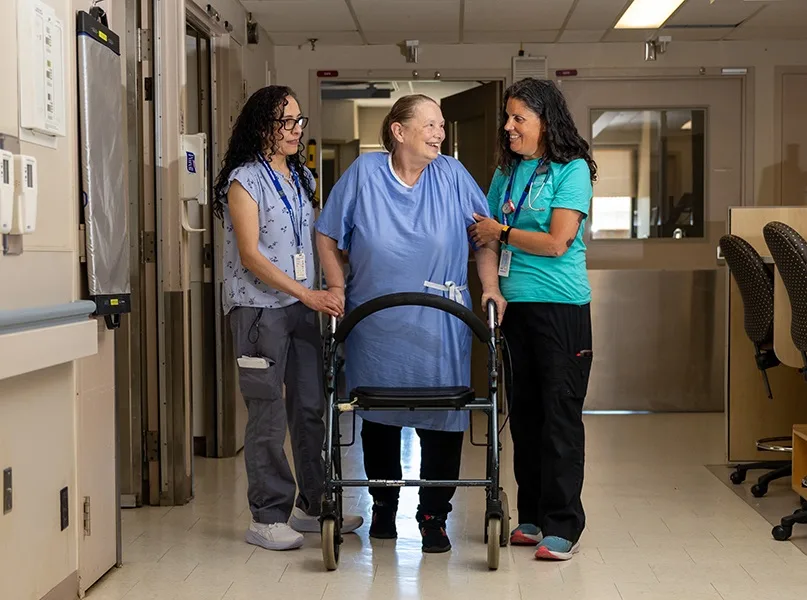
Investment in St. Joe’s’ Neonatal Intensive Care Unit (NICU), a new Psychiatric Emergency Service (PES) emergency room (ER), and a new Reactivation Care Unit (RCU) will address urgent patient needs.
“There are three key projects that impact our continuum of care. The NICU is important because we deliver around 3,500 babies annually – about nine each day. It will expand to accommodate this need.
“Furthermore, we’re renovating the unit to improve infection control, privacy, and provide parents with some alone time,” outlines Heenan.
These upgrades will not only increase capacity but also support anxious parents with newborns facing challenges, helping to stabilize their infants and promote a healthy future.
In addition, the PES ER at SJHH is expanding from 11 to 22 beds.
“The current facility, built 25 years ago, needs urgent renewal. With support from the Ontario government, the new space will offer increased privacy, enhanced safety features, and a consultation room for families, which we currently lack. Moreover, patients can arrive voluntarily with family support or be brought in by police for safety.
“This expansion will provide dignity to those struggling with mental health and addictions and will double our capacity to support individuals in need,” he enthuses.
Finally, the RCU at one of the LTCHs will provide 57 post-acute care beds that will serve both St. Joe’s and other regional hospital patients.
“We are partnering with Hamilton Health Sciences to offer transitional care for patients completing their acute medical or surgery stays. This facility will support patients before they return home or move to another care facility.
“The advantage of our set-up is that we repurposed an empty floor and collaborated with the Ontario government for renovations, allowing us to integrate hospital services within the LTCH,” explains Heenan.

“Each day, we manage 12 vulnerable patients, providing wraparound services and support without judgment, as homelessness can stem from various issues like economic hardship or domestic problems”
Mike Heenan, President and CEO, St. Joseph’s Health System
STRENGTHENING SAFETY
In Canada, 61 percent of nurses experience workplace violence, with 50 percent occurring in ERs.
According to the World Health Organization (WHO), eight to 38 percent of healthcare workers globally have been assaulted in the past year. Therefore, addressing this issue is a priority at St. Joe’s.
“The board and senior leadership closely monitor reported incidents and lost time due to injuries. Over the last three years, we’ve seen a 44.4 percent increase in reported incidents of verbal, physical, and racial abuse, indicating that staff feel more comfortable reporting issues.
“The good news is that even with that increase in reporting, our workplace is safer with a 43.7 percent decrease in lost time injuries,” notes Heenan.
St. Joe’s actively encourages reporting, and its key initiatives include fostering an open culture, allowing staff to enter patient rooms in pairs for added safety, and implementing training to assess and manage challenging situations.
“Security measures have been enhanced with additional guards and cameras, and room designs now include two exits for emergencies,” he urges.
Later in the year, St. Joe’s’ home care division will introduce new technology that allows visiting nurses to check in via their phones when arriving at and leaving a home.
“If a nurse feels threatened during an interaction, they can press a button to call for help, as our staff work in various environments.
“In the ER, they are familiar with the layout and one another, but home care is different,” acknowledges Heenan.

PERFORMANCE PROGRESS
St. Joe’s has shown significant progress in research and performance metrics, as highlighted by improved patient-doctor communication and a notably low mortality rate.
The Research Institute of SJHH, established around 15 years ago, has successfully risen in the rankings to 21st a 40 among Canadian research hospitals, up from 27th just five years ago.
“We aim to break into the top 20, particularly since we are affiliated with McMaster University, one of Canada’s top five universities. Additionally, our annual research funding has increased from CAD$27 million to CAD$52 million, reflecting our expanding research footprint,” reports Heenan.
St. Joe’s conducts research across various fields, including surgery, medicine, emergency medicine, respirology, ophthalmology, and mental health, with a particular focus on addictions and renal care.
This diverse approach allows the hospital to apply innovative research findings directly to patient care.
In addition to research, St. Joe’s is a high-performing healthcare provider due to its focus on quality improvement.
At its main hospital site, St. Joe’s has Ontario’s best ER wait time compared to other teaching hospitals, seeing a doctor within 2.5 hours compared to an average of 4.3 hours.
The hospital also has a low mortality rate post-major surgery at 1.1 percent compared to an Ontario average of 1.6 percent.
In its LTCHs, the system has improved the percentage of residents experiencing pain from a high of 2.3 percent five years ago to 1.2 percent in 2025-26. This score is ahead of both the Ontario and Canadian benchmarks of 4.6 percent and 5.5 percent.
The system has also reduced LTCH resident transfers to the emergency department (ED) from a high of 22 percent five years ago to 16.3 percent in 2025–26, which is ahead of the Canadian benchmark of 22 percent.
Moreover, St. Joe’s’ home care division has just launched a new program in Kitchener-Waterloo called Hospital to Home, which ensures a nurse visits a patient within the required 24 hours after hospital discharge 100 percent of the time.
“We’re not just a hospital; we aim to provide various types of care. Excess land allows us to build facilities cost-effectively, underscoring our commitment to community care”
Mike Heenan, President and CEO, St. Joseph’s Health System
TRANSFORMING LAND INTO LIFELINES
Plans are underway to develop up to 75 acres of unused land owned by St. Joe’s through various community projects.
“We are fortunate enough to operate on private, charitable land as a publicly funded health system, allowing us to consider how we use it in a way that aligns with our mission.
“Furthermore, we have excess land in areas such as Kitchener-Waterloo and Guelph, as well as in some of the communities we serve, including Brantford and Stony Creek. We are currently exploring partnerships with developers to use these lands for ongoing service,” announces Heenan.
For instance, in Guelph, with a population of approximately 400,000, St. Joe’s plans to establish a 160-bed LTCH.
This facility will include an Indigenous health component with designated beds for the care of Indigenous peoples. Importantly, the design will be led by Indigenous communities rather than St. Joe’s, granting them the opportunity to shape their own care environment.
“Health systems worldwide are facing rising costs and reimbursements as public funds become tighter. To address this, we are considering utilizing some of our land to generate revenue streams.
“Moreover, with no shareholders, any financial returns will be reinvested back into care services. This unique advantage allows us to explore various models for sustainable growth,” he tells us.
St. Joe’s has utilized its lands for meaningful projects, such as two hospices – one in Brantford and another in Dundas, Hamilton – to care for both elderly and young individuals.
“We’re not just a hospital; we aim to provide various types of care. Excess land allows us to build facilities cost-effectively, underscoring our commitment to community care,” Heenan ardently concludes.
This company profile was produced by the editorial team at North America Outlook, a publication within the Outlook Publishing global network of B2B industry magazines.
Outlook Publishing showcases organisations and leadership teams shaping sectors including manufacturing, mining, construction, healthcare, supply chains, food production, and sustainability.
North America Outlook highlights organisations driving innovation and industry leadership across North America.