





Widely recognized as a beloved brand across the island, Digicel Jamaica is a cornerstone of the community with industry-leading telecommunications solutions that are purposefully made to serve the population. Stephen Murad, CEO, emphasizes the company’s critical disaster recovery services following Hurricane Melissa, which are underpinned by the enduring spirit of the Jamaica people.
RECONNECTING JAMAICA, ONE SMILE AT A TIME
Across the world, telecommunications (telecoms) organizations have historically stood as incumbents to liberalization and key markers of a nation’s progress, whether it be the creation of a national telephone service or introduction of a landline.
This is certainly the case for Jamaica; at a time of great economic liberalization in the late 1990s, the Government of Jamaica launched a tender for a new license contract that telecoms operators could bid for, therefore helping to drive competition in the country.
Winning the bid and sparking an era of change in the nation’s industry landscape was Digicel Jamaica (Digicel), officially launched on 19th April 2001 and now the beating heart of telecoms on the island.
“Digicel excelled at tried and tested things that are now standard in the industry, changing the face of the telecoms space and being key to the mobile phone sector exploding in the last 20 years,” opens Stephen Murad, CEO.
Indeed, the company spearheaded the effective distribution of products, ensuring that there were enough retail outlets on the streets to service customers wherever they were, as well as promoting SIM card use and the latest mobile phones to attract people to the network.
“Digicel did well at building a real brand from scratch, which Jamaica was ready to embrace,” he enthuses.
PAINTED IN RED
The Digicel brand soon took off across the nation, as the company’s products could be found on bus shelters and sold by red-bibbed street sellers alongside everyday groceries.
“People often said, ‘Digicel painted the town red’. In a country where green, black, and gold symbolize national pride, the sudden splash of vibrant red marked a bold transformation in Jamaica’s telecoms landscape,” Murad recounts.
The company also tapped into and focused on concepts that are important to Jamaican culture, to include music, sport, and athletics in particular. Jamaica has some of the world’s most famous Olympians, such as Usain Bolt who became an ambassador in 2004 and lifetime ambassador in 2016, and Shelly-Ann Fraser-Pryce who became an ambassador in 2008.
“Digicel also had the foresight to focus on other things like supporting music events and getting ‘on the ground’ in the communities. For example, whenever a mobile tower was switched on, there would be a local street party with music, food, Red Stripe, and rum to celebrate.
“It was such an occasion because it meant everyone in the community had access to a service they could use at an affordable rate,” he continues.
More broadly, Digicel introduced many innovations that are now taken for granted as industry standard, such as mobile phone contracts that use per-second billing.
“The company really flooded the market and got a huge sway, ultimately changing the competitive landscape and making operators reflect on what they were doing and what could be done differently.”
Today, the Jamaican market stands shoulder to shoulder with the global telecoms sector and is experiencing a rapid increase in the use of smartphone technology.
“There is very high smartphone penetration in Jamaica, so we have to ensure we have the right products and services to serve our customers,” Murad affirms.
“Digicel excelled at tried and tested things that are now standard in the industry, changing the face of the telecoms space and being key to the mobile phone sector exploding in the last 20 years”
Stephen Murad, CEO, Digicel Jamaica
SECURING CONNECTIVITY
Celebrating its 25th anniversary this year, Digicel is proud to be born and bred in Jamaica, at the helm of a global footprint comprising 25 different countries across the Caribbean and Americas.
As a growing group of companies, the organization boasts a vast product portfolio serving business customers in ICT services, cybersecurity, cloud, and wireless access networks, to name a few, as well as boasting the only Tier 3 data center in Jamaica.
A key element of the company’s disaster recovery efforts is its advanced security-as-a-service capabilities, including artificial intelligence (AI)-based CCTV, vulnerability assessments, cyberthreat protection, and much more.
Meanwhile, its software-as-a-service (SaaS) products allow users to use cloud-based apps, services, and emails, including Microsoft Office, of which Digicel is a key reseller.
The company also creates products that are tailored to fit Jamaica’s corporate and commercial needs, including pre- and post-paid business services for consumers and delivering full-fiber networks to both homes and businesses.
The company operates predominantly through 32 business-owned retail stores alongside over 400 third-party resellers. These include mom-and-pop grocers, electronics stores, lottery outlets, and gas stations, where customers can buy a SIM card, top up, buy a phone, pay their bill, and access a plethora of other services.
Digicel also has a large digital footprint where its customers can access a wealth of products and useful services online from the convenience of their device, facilitated through its state-of-the-art ‘MyDigicel’ app.
The company is proud to service over two million mobile customers in Jamaica, delivering cutting-edge solutions to a sizeable proportion of the country’s population.

RECONNECTING JAMAICA
Digicel possesses an unwavering focus – ‘Reconnecting Jamaica’ – which is a clear demonstration of its vital and unwavering disaster recovery products.
Following the devastation of Hurricane Melissa – a Category 5 hurricane that made landfall in October – the company is helping to rebuild the country and support those most in need.
“Following the catastrophic event, we came up with ‘Reconnecting Jamaica’ because that’s our job today,” Murad asserts.
Going above and beyond its telecoms responsibilities, Digicel is working alongside the government to shape the country’s disaster recovery.
“I was in Parliament recently giving an update on our ‘Reconnecting Jamaica’ efforts, where MPs asked questions around rebuilding, restoration, and recovery. There were also queries on how dependent Digicel is on the national grid, road networks, and other forms of infrastructure,” Murad details.
With this in mind, the company must make key considerations around how it revives national commerce, adopting a two-pronged approach that revolves around Jamaican businesses, government services, hospitality, manufacturing, and business process outsourcing (BPO) sectors, to name but a few.
“Jamaica serves as a key holiday destination, particularly for the US, Canada, and UK. In fact, hospitality is an approximately USD$4 billion industry in the country with about four million visitors per year, so it’s a significant sector,” Murad points out.
In support of the hospitality sector, Digicel is reconnecting hotels to ensure they have the effective internet connectivity to run smoothly, facilitating their internal booking systems, wireless guest networks, on-premises internet protocol television (IPTV), and much more.
The second area of focus is reconnecting Jamaica’s BPO sector, which utilizes Digicel’s cutting-edge technology to create customer contact centers for the east coast of the US and Canada. Digicel’s Jamaican operations are ideally situated to serve these areas due to the country’s proximity and minimal time difference.
Jamaica is also home to a significant population of highly educated and trained workers, with three reputable universities recognized across the region as top educational institutions.
As a result, the country has a high population of English speakers who have a good understanding of UK and US culture. Therefore, many companies across North America take advantage of these factors, making Jamaica a key hub for customer contact centers.
More broadly, Digicel is also helping to boost the local economy by providing connectivity to businesses that were impacted by the hurricane. This, in turn, will allow customers to effectively utilize and pay for services.
“Many companies suffered immense damage to their operations, which means they had to move to a temporary location or relocate entirely, so we’ve made sure they’re well-connected.
“The quicker we get them back online, the sooner these industries can generate cash again,” Murad states.

IN TUNE WITH THE NATION’S PROGRESSION
As part of its ongoing disaster recovery efforts, Digicel is paying attention to Jamaica’s existing infrastructure and assessing how this can be improved to not only provide greater connectivity but also futureproof the country against other extreme weather events.
“We have many climate issues in the hurricane belt, but we have to manage and deal with these things as efficiently as possible.
“Jamaica is at a crossroads; it’s looking at changing the building codes again and adapting infrastructure, coupled with the fact we’re going to get hit again in the future, so it’s been a wake-up call,” Murad attests.
As such, Digicel is in tune with many major changes being made to the country’s infrastructure, which subsequently inform the company’s ongoing projects and investment decisions.
For instance, if new building codes are introduced, the company will need to assess how this will impact the provision of home internet services.
On the flip side, Digicel is also assessing how Jamaica’s development will impact its trajectory going forward.
“We are making investment decisions that revolve around how best to protect the business in Jamaica while also still continuing to grow,” he deliberates.
Over the post-COVID-19 pandemic years, Digicel has been growing at an unprecedented rate, which evokes a lot of confidence in Jamaica’s economy and has a ripple effect on those operating within the country.
Within this context, the company is laser-focused on infrastructure and how it can be leveraged to best service customers and build connectivity across Jamaica following Hurricane Melissa.
Case in point, Digicel recently signed an agreement with a highway operator to implement underground duct infrastructure for better fiber connectivity, safeguarding internet access from future catastrophic events or natural disasters.
“Fiber is critical – we are a fiber-only business as we don’t have the legacy infrastructure that other operators do.
“We are therefore putting more fiber in the ground that will help protect and generate incremental revenue, so we’re able to better serve people with super-fast speeds.”

AT THE FOREFRONT OF OPERATIONS
Although it may not be the largest in terms of population, Jamaica stands as the most significant contributor to the Digicel Group across the Caribbean, with the greatest revenue and earnings before interest, taxes, depreciation, and amortization (EBITDA).
This is demonstrated by the number of international businesses operating in the country – including Sandals Resorts, DHL, and PwC, among others – alongside significant banking infrastructure, making it stand out in the Caribbean business landscape.
This unparalleled position across the region can be attributed to the tenacious spirit of the Jamaican people, who have a forward-thinking approach to business and operational expansion.
“Jamaica is a phenomenal place to do business and grow. It has so many elements of untapped potential, and I think it’s the jewel of the Caribbean, with the environment and people to make a company successful,” Murad prides.
Beyond Jamaica, Digicel extends its disaster recovery efforts across the Caribbean with a comprehensive business continuity management team who manages operations on a group-wide level.
“You can get two or three Caribbean islands hit by hurricanes in the same year. So, we need to be the captain or quarterback of the team to manage key logistics and decisions in such an event, especially looking at how we transport materials and ensure they are kept outside of the hurricane belt,” he reflects.
Indeed, Digicel stores essential infrastructure in places such as Panama and Trinidad, where they can be easily accessed and transported in critical situations.
Extra materials and crew from areas such as Trinidad and Haiti have also been brought in to help with the restoration efforts in Jamaica, emphasizing the power of the group.
Elsewhere, having relied on generators in recent months due to the national grid losing power, the company also regularly assesses mass fuel distribution methods as a precautionary measure.
“You need to have a sufficient supply of fuel to service generators that could be running for months on end or even replace faulty parts,” he explains.
Digicel additionally runs regular drills and physical table-top exercises in case of emergencies, ensuring all staff remain safe at work.

“Jamaica is a phenomenal place to do business and grow. It has so many elements of untapped potential, and I think it’s the jewel of the Caribbean, with the environment and people to make a company successful”
Stephen Murad, CEO, Digicel Jamaica
HEART OF THE COMMUNITY
Digicel cares deeply for the well-being of its people, particularly in times of natural disaster. The company has been focused on providing immediate relief for its 1,000-strong staff base.
“We provided each of them access to care packages as they have also been seriously impacted by the hurricane. Some staff have lost the roofs of their homes or had to live with their friends and family,” Murad notes.
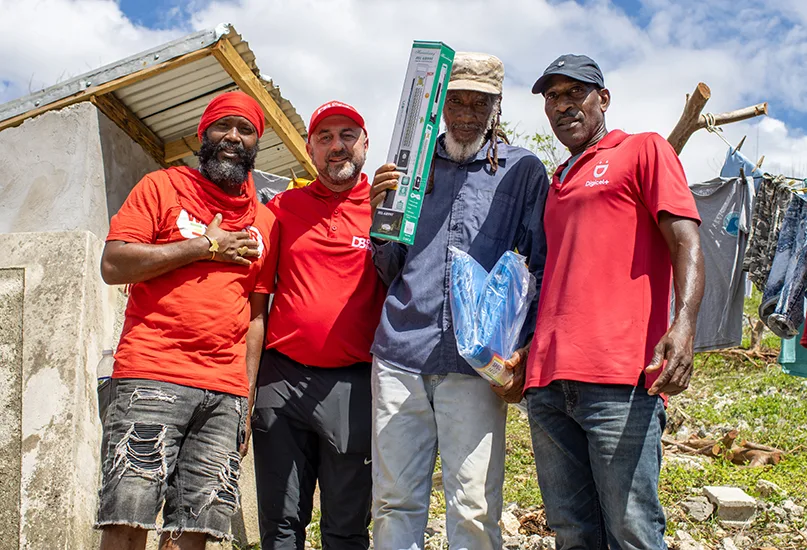
Employees have also been on the ground in local communities delivering care packages containing simple but vital items such as drinking water, diapers, wipes, and chargers for electronic devices.
The company has also introduced temporary stores for people to replace their phones if they have been lost or damaged.
Moreover, as part of its work with the government, Digicel is helping to restore important documents that were lost in the flooding for locals.
“Communities have lost everything and it’s heartbreaking to see, so we’ve been taking essential agencies with us on the road to help people get their important documentation back,” assures Murad.
This is particularly vital for people who may not be able to travel to the capital, Kingston, or other metropolitan areas, making Digicel’s outreach programs even more important.
“It may seem a bit odd for a telecoms company to do that, but that’s the Digicel DNA that I go back to all the time – we are completely unselfish,” he urges.
The company’s laser focus of ‘Reconnecting Jamaica’ is underpinned by the unwavering dedication of its staff.
“Nobody is taking a day off because they are fully committed to recovering our country. That is the energy and pride Jamaicans have in abundance.
“The passion of the people and their relentless drive to reconnect as quickly as possible is key to a speedy recovery,” Murad prides.
“The passion of the people and their relentless drive to reconnect as quickly as possible is key to a speedy recovery”
Stephen Murad, CEO, Digicel Jamaica
BUILDING COMMUNICATIONS
At the heart of the company’s corporate social responsibility (CSR) strategy is the Digicel Foundation, which was founded as an independent facet of the business dedicated to helping the community.
The foundation’s focus areas are education, special educational needs and disabilities (SEND), and community development. In the last 21 years, the foundation has contributed over USD$48m to supporting these pillars.
This includes the launch of 21 smart labs in schools in recent years, each equipped with next-generation technology.
“We train teachers on how to use technologies like Google Classroom or smart boards and get the best out of them as a teaching resource,” Murad tells us.
Participating schools sign a mutual pledge to take care of the teaching technology and achieve target grades. Alongside smart classrooms, the Digicel Foundation keenly supports numerous schools for people with disabilities by providing purpose-built therapy rooms and sensory gardens.
“As well as helping from an education standpoint, there’s also a key element of quality involved in that education too,” Murad observes.
Furthermore, the foundation’s Safer Internet Together (SIT) Program, which was rolled out at the beginning of last year and highlights the importance of online safety, digital responsibility, and cyber awareness.
“As part of the initiative, we hold educational sessions in schools with kids and teachers, while inviting family members to come along too. Being a key industry player, we recognize the part we need to play in helping and educating people on how best to protect themselves online.”
The Digicel Foundation also excels in getting small local businesses off the ground by offering grants to both existing companies who want to achieve a new goal or emerging start-ups who need help finding their feet.

A RECONNECTED FUTURE
Over the next year, Digicel plans to advance its ‘Reconnecting Jamaica’ efforts by adopting a sustainable approach.
For example, the company aims to convert a large proportion of its mobile towers to solar power and explore alternative energy solutions to reduce its dependence on unstable resources such as the national grid.
“The environment plays a huge part in that. We can harness the power of the sun to provide connectivity through cell towers when services go down due to natural disasters and extreme weather events,” Murad highlights.
This is even more prevalent given the recent devastation of Hurricane Melissa and the company’s reliance on generators to power its towers after the national grid was damaged.
“The grid is being rebuilt as quickly as possible, but Jamaica is a relatively large island and it’s a huge effort to restore it quickly, so we definitely want to diversify into alternative energy solutions,” he sets out.
Digicel will also continue to keep pace with major government infrastructure projects to better navigate disaster recovery in the future.
“Will they rebuild in different places and move homes from flood-prone areas? If that’s the case, we need to rethink where we put our infrastructure and towers,” Murad asserts.
Indeed, the company will begin to analyze where populations relocate, particularly those moving from rural areas to major towns and cities for greater protection and stronger infrastructure.
Home-building projects in particular will majorly accelerate in the next 12 months to help rebuild the country.
“This will facilitate the need for home internet access, so we need to have a clear idea of where these homes are going to be built and map our infrastructure accordingly to best service them.
“Being in step with these plans will be critical to ensuring we can continue ’Reconnecting Jamaica’,” Murad concludes.
DIGITAL JAMAICA PARTNERS