




Striving to protect and enhance the integrity of the financial services industry in the territory, the Cayman Islands Monetary Authority is safeguarding the islands’ financial landscape. We sit down with Cindy Scotland OBE, CEO, who outlines the authority’s strategic plan for the years ahead.
FIRM FINANCIAL FOUNDATIONS
Driven by rapid technological innovation and increasingly stringent international regulatory standards, the global financial services industry has undergone a significant transformation of late.
Digitalization has accelerated, influencing everything from payment systems to customer onboarding and cross-border transactions.
At the same time, geopolitical pressures and macroeconomic shifts have resulted in a complex environment that demands agility, transparency, and strategic foresight from regulators.
This has also resulted in heightened expectations from international bodies such as the Financial Action Task Force (FATF), International Organization of Securities Commissions (IOSCO), the Organisation for Economic Co-operation and Development (OECD), and the Basel Committee on Banking Supervision (BCBS).
For the Cayman Islands Monetary Authority (CIMA), these changes present both challenges and opportunities.
On one hand, the rapid emergence of virtual assets, artificial intelligence (AI)-enabled financial tools, and new business models have required the continuous refinement of supervisory frameworks and expertise.
On the other, these developments offer a unique opportunity to enhance regulatory efficiency, adopt more sophisticated technology, and further reinforce the Cayman Islands’ reputation as a globally respected and forward-thinking financial center.
“Our challenge has been to maintain the right balance between encouraging innovation and safeguarding the jurisdiction, ensuring we remain competitive while upholding our commitment to market integrity and global compliance,” opens Cindy Scotland OBE, CEO of CIMA.
As the Cayman Islands’ primary financial services regulator, the authority is responsible for the licensing, regulation, and ongoing supervision of a diverse range of sectors, including banking, insurance, securities business, mutual and private funds, fiduciary services, credit unions, money services, and, more recently, virtual asset services.
“Our mandate extends beyond supervision to encompass the issuance and management of the local currency, as well as providing strategic advice to government on the regulation of financial services and compliance with international standards, national policy, and long-term economic direction,” Scotland declares.
Because of the breadth of CIMA’s regulatory responsibilities, its stakeholder base is equally extensive, including international standard-setting bodies, government ministry and agency partnerships for policy and enforcement, and the general public who rely on a stable, secure, and trustworthy financial system.
“Each group interacts with CIMA in different ways, but all are integral to the overall health and resilience of the jurisdiction,” she details.
RESILIENT, RELEVANT, AND RESPONSIVE
On a mission to protect and enhance the integrity of the financial services industry of the Cayman Islands, CIMA maintains a disciplined, risk-based supervisory approach that allows it to identify areas of concern early, respond proportionately, and maintain a strong line of sight across the many facets of the sector.
“We ensure that our regulatory frameworks remain relevant, responsive, and aligned with global expectations and support consumer protection,” Scotland affirms.
At the same time, CIMA works closely with stakeholders to ensure emerging and innovative business models, such as financial technology (FinTech), are supported by carefully designed regulatory frameworks that uphold integrity while safeguarding investor and public interests, in addition to maintaining the jurisdiction’s reputation.
“Transparency, accountability, and engagement are central to how we operate.”
Cultivating an internal culture of excellence and ongoing professional development, CIMA enables its teams to carry out their responsibilities with clarity, confidence, and integrity.
“In these ways, we not only uphold our mission but embody it through measurable action,” she states.
The authority’s strategic importance as a regulator lies in its ability to uphold the integrity of the local financial services landscape, actively contributing to and supporting the development of international regulatory standards.
It works closely with global standard-setting bodies and overseas authorities to strengthen cross-border supervision and combat financial crime.
“Ultimately, our work protects not only the jurisdiction’s economic interests but also its global standing, serving as a guardian of the Cayman Islands’ financial integrity.
“We also work to safeguard public interest by promoting fair, sound, and transparent practices when providing financial services, thereby supporting consumer protection and reinforcing trust in the financial system,” Scotland outlines.
“We ensure that our regulatory frameworks remain relevant, responsive, and aligned with global expectations and support consumer protection”
Cindy Scotland OBE, CEO, Cayman Islands Monetary Authority
A GUIDING STRATEGY
CIMA recently outlined its 2024–2026 Strategic Plan, which acts as a roadmap for the authority during this period, articulating the values that define its institutional character and the standards to which it holds itself.
“The plan also introduces a structured delivery model that clearly connects our inputs, activities, and outputs to the outcomes we seek to achieve for the supervision of the financial services industry and the broader community,” Scotland highlights.
Central to the plan are six key objectives, which focus on enhancing technological capability, combatting financial crime, establishing robust frameworks, positioning CIMA as an employer of choice, safeguarding the Cayman Islands’ currency, and expanding public outreach.
“Together, these objectives form a coherent, forward-looking plan that prepares CIMA for the challenges and opportunities of the coming years.”
In particular, strategies focusing on virtual assets, anti-money laundering (AML), corporate governance, and alignment with international standards are intended to strengthen the authority’s existing regulatory framework.
“The initiatives, which form the backbone of our efforts, are not only relevant to the evolving financial landscape but also resilient and internationally credible,” she adds.
Well-defined licencing regimes, for example, strengthen CIMA’s supervisory methodologies, while the rapid growth of virtual assets underscores the need for clear, robust, and forward-looking regulation.
As such, the authority is ensuring that the Cayman Islands remains a responsible jurisdiction for digital innovation as it balances opportunity with strong safeguards and market integrity.
The authority’s AML and countering the financing of terrorism (CFT) effectiveness is an equally critical component.
“As financial crime continues to grow in complexity, so too must our efforts to identify, assess, and mitigate related risks,” Scotland observes.
Through the enhancement of data systems, refinement of supervisory methodologies, and deepening of inter-agency cooperation, CIMA is better positioned to detect and address illicit activity.
A deep commitment to strong corporate governance is another foundational element of the Cayman Islands’ healthy financial system, alongside the adherence to global best practices which safeguards the long-term resilience of the financial services sector.
“Together, these priority areas reinforce a regulatory environment that is agile, modern, and internationally respected,” she points out.
GLOBAL PRESENCE
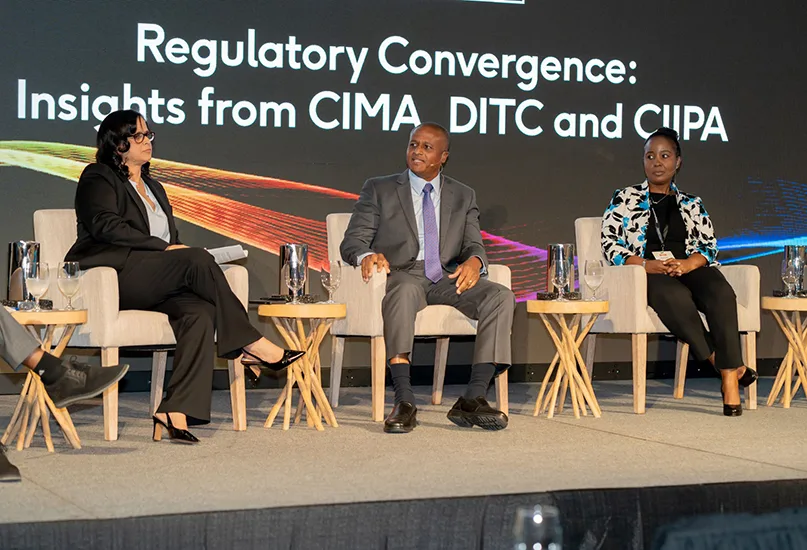
As CIMA seeks to establish itself more prominently on the international stage, it’s going forward with a deliberate blend of active engagement, technical expertise, and visible leadership.
“As the global regulatory environment grows increasingly complex, our role extends beyond domestic supervision and into the broader international dialogue that shapes the standards of the financial services sector worldwide,” Scotland discloses.
CIMA is deepening its participation at international and regional bodies such as IOSCO, the BCBS, FATF, the Group of International Finance Centre Supervisors (GIFCS), Financial Stability Board (FSB), International Association of Insurance Supervisors (IAIS), and Network for Greening the Financial System (NGFS).
“We engage not only through participation in working groups and consultations, but by contributing substantive, informed perspectives that help shape emerging policy, regulatory approaches, and supervisory frameworks, strengthened by our ongoing investment in technical capacity,” she surmises.
CIMA is equipping its teams with the necessary expertise to offer meaningful contributions to global discussions through assets, risk-based supervision methodologies, and sustainable finance, positioning the Cayman Islands as a jurisdiction that doesn’t simply adopt international standards, but shapes them.
“Just as important as our international participation is the effort we place on transparency and communication. A regulator’s credibility depends not only on the strength of its frameworks, but on its ability to articulate its priorities clearly and consistently,” Scotland sets out.
CIMA is therefore enhancing its visibility by providing increased domestic and international insight into its regulatory processes, expectations, and strategic direction.
“Through thoughtful communication, we help to demystify our operations and build trust among stakeholders, from industry partners to peer regulators and global standard-setters,” she adds.
In addition, strong partnerships with counterpart regulators have set CIMA apart, enabling collaboration around supervisory matters and ensuring that the jurisdiction’s perspective is represented within influential conversations – particularly those related to emerging risks and opportunities in global finance.
“Ultimately, our aim is to reinforce the Cayman Islands’ reputation as a jurisdiction grounded in excellence, collaboration, and regulatory integrity,” Scotland assures.
“By marrying technical sophistication with proactive engagement and transparent communication, CIMA continues to position itself – and the Cayman Islands – as a thoughtful, credible, and forward-looking contributor to the global regulatory community.”
SUCCESS BUILT ON COLLABORATION
It’s important to note that CIMA’s success is not achieved in isolation but built on the strength of its partnerships with key stakeholders across government, industry, and the international regulatory community.
“Effective regulation in today’s interconnected financial environment requires cohesive and coordinated action, and we are fortunate to operate within a jurisdiction that values and prioritizes this collective approach,” Scotland explains.
Cross-governmental engagement is particularly essential, with CIMA’s work closely linked to a range of public-sector partners whose mandates intersect with financial services.
“Close coordination with ministries, statutory authorities, and law enforcement agencies ensures that our regulatory efforts are supported by clear policy direction, sound legislative frameworks, and robust enforcement capabilities.”
This multi-agency collaboration strengthens CIMA’s national posture in areas such as AML and CFT, financial crime prevention, and international compliance, ultimately reinforcing the integrity of the entire jurisdiction.
Equally important is the relationship the authority maintains with the financial services industry, which includes active dialogue and a sense of shared responsibility between the regulator and those it supervises.
“This engagement ensures that our frameworks remain relevant, practical, and effectively aligned with global expectations, while still supporting innovation and sustainable growth,” Scotland emphasizes.
International partnerships also play a pivotal role in CIMA’s ability to maintain open communication with peer regulators, participate in global standard-setting discussion, and contribute to international working groups helps it ensure the Cayman Islands’ voice is heard and understood within a broader global context.
“These relationships not only enhance our technical understanding but also reinforce the Cayman Islands’ position as a jurisdiction committed to transparency, cooperation, and regulatory excellence,” she discloses.
None of this, however, would be possible without the dedication of CIMA’s staff, whose deep expertise, professionalism, and commitment are central to everything it accomplishes.
“The complex and evolving nature of global finance demands rigorous analysis, thoughtful supervision, and continual adaptation – all of which rely on the strength and dedication of our people,” Scotland adds.
In short, the Cayman Islands’ standing as a respected global financial center is the product of a collective effort, upheld through strong public-private partnerships, constructive industry relationships, meaningful international engagement, and the unwavering commitment of staff.
“Collaboration is not simply beneficial; it is foundational to our continued success and the long-term resilience of the jurisdiction,” she shares.
“Effective regulation in today’s interconnected financial environment requires cohesive and coordinated action, and we are fortunate to operate within a jurisdiction that values and prioritizes this collective approach”
Cindy Scotland OBE, CEO, Cayman Islands Monetary Authority

A MEANINGFUL CONTRIBUTION
CIMA’s commitment to the Cayman Islands extends far beyond its regulatory mandate, as it places significant emphasis on contributing meaningfully to the socioeconomic and educational fabric of the community.
“This philosophy guides many of the initiatives we undertake each year, with our efforts rooted in the belief that a strong, informed, and connected community shapes the foundation of a resilient financial services industry,” Scotland reflects.
Supporting the development of local talent is a key priority, with the authority actively participating in and sponsoring educational initiatives that enhance financial literacy, create pathways into the financial services sector, and nurture early interest in regulation and compliance.
A highlight of this commitment is the annual CIMA Student Mixer & Career Fair, hosted in partnership with local industry stakeholders.
“This event brings students and financial professionals together in a dynamic networking environment, offering young people valuable exposure to career opportunities and mentorship within the sector,” she elaborates.
The fair has become an important bridge between the classroom and the world of work, and an event the authority is proud to champion.
CIMA’s broader community engagement is equally meaningful, with CIMA staff regularly volunteering to support charitable organizations, environmental programs, and social initiatives across the islands, while also conducting internal fundraising campaigns throughout the year.
“These efforts reflect a collective desire among staff to give back, and they reinforce a strong sense of purpose within the authority,” Scotland observes.
A signature community endeavor is the CIMA 5K Walk/Run, which supports charitable causes while promoting health and wellness and has become a highly anticipated fixture on the community calendar, underscoring the role the authority plays in fostering unity and social engagement.
Beyond internal efforts, CIMA remains committed to constructive engagement with the financial services industry, hosting a wide range of outreach events that facilitate dialogue, enhance regulatory understanding, and strengthen collaborative relationships.
“These engagements reflect our broader goal of building a transparent, well-informed, and resilient financial ecosystem,” she smiles.
Collectively, these initiatives represent CIMA’s dedication to supporting the long-term well-being, talent development, and community strength of the Cayman Islands.
“We view this work as an extension of our mission, because a strong community and strong financial system go hand in hand,” Scotland imparts.
“By investing in technology, expanding our organizational capacity, undertaking a thoughtful restructuring, and strengthening our relationships locally and globally, we are preparing ourselves for a future defined by innovation, competitiveness, and long-term resilience”
Cindy Scotland OBE, CEO, Cayman Islands Monetary Authority
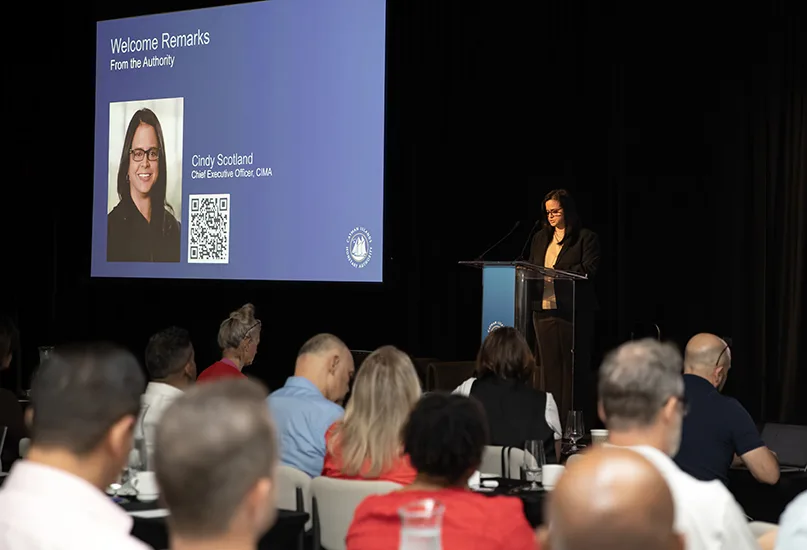
FUTURE FOCUS
Looking ahead, CIMA’s priorities are centered around strengthening its regulatory foundations and preparing the organization for the next phase of growth, innovation, and global integration.
A significant element of this involves continuing to modernize its regulatory framework so it remains agile, globally aligned, and capable of responding to emerging risks and opportunities across the financial services landscape.
This includes refining relevant legislation, enhancing supervisory methodologies, and ensuring that the Cayman Islands’ regulatory architecture continues to reflect the highest international standards.
“Technological transformation remains a priority, and CIMA must continue investing in the systems, tools, and analytical capabilities that support effective, data-driven supervision.
“We are also enhancing operational efficiency by leveraging data-driven decision-making, advancing digital transformation, and establishing centers of excellence across our divisions,” Scotland explains.
As the regulatory environment continues to expand and diversify, capacity building will also be a defining focus for the authority, particularly when it comes to virtual assets, FinTech, sustainable finance, and innovative investment structures.
“This includes growing our team through targeted recruitment, upskilling existing staff through continuous professional development, and enhancing leadership capacity, ensuring we can maintain the depth of oversight required of a modern, global regulator,” she insights.
In line with these goals, CIMA is preparing for a significant organizational restructuring to improve operational efficiencies, reduce redundancies, and better align its structure with the evolving regulatory landscape to become a resilient, future-ready business.
The jurisdiction continues to see strong interest in emerging sectors such as crypto or virtual currencies, payments innovation, and climate-related financial products.
CIMA’s responsibility is to ensure this growth is supported by a forward-looking regulatory environment for whom safeguarding financial stability and maintaining integrity is a priority.
Strengthening engagement and open dialogue with both local and international stakeholders is also a key focus, helping to ensure that the Cayman Islands’ regulatory ecosystem continues to be understood, respected, and trusted by stakeholders across the world.
“Ultimately, our goals are grounded in a commitment to excellence. By investing in technology, expanding our organizational capacity, undertaking a thoughtful restructuring, and strengthening our relationships locally and globally, we are preparing ourselves for a future defined by innovation, competitiveness, and long-term resilience,” Scotland passionately concludes.
CAYMAN ISLANDS MONETARY AUTHORITY PARTNER