Neil Perry is Content Director for Outlook Publishing.
- Content Director
Share
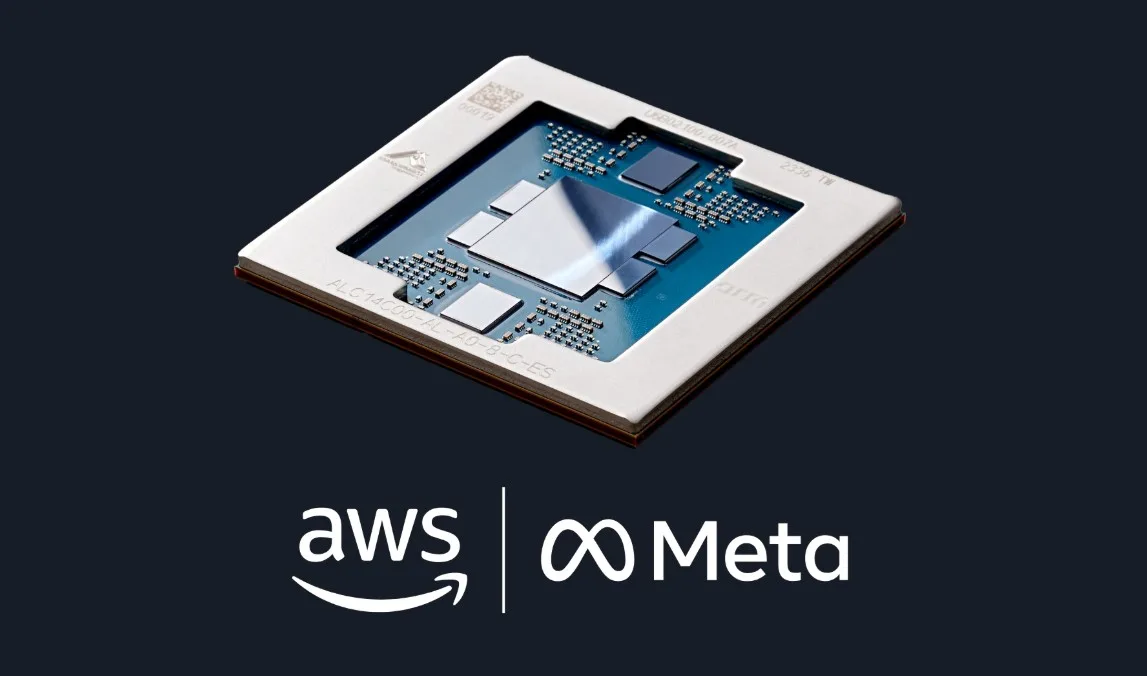
Meta has signed an agreement to deploy Amazon Web Services Graviton processors at scale, marking a major expansion of its long-standing partnership with AWS as the company builds its next generation of AI infrastructure.
Meta expands AWS partnership for agentic AI workloads
The deployment begins with tens of millions of Graviton cores, with flexibility to expand as Meta’s AI capabilities grow, making Meta one of the largest Graviton customers in the world.
The agreement reflects a broader shift in enterprise AI infrastructure, where agentic AI workloads are creating growing demand for CPU-intensive processing alongside traditional GPU-heavy model training.
AWS said the deal builds on Meta’s long-standing relationship with the cloud provider and its use of Amazon Bedrock at scale to support next-generation AI.
While GPUs remain critical for training large models, AWS said the rise of agentic AI is driving demand for CPU-intensive workloads such as real-time reasoning, code generation, search, and orchestrating multi-step tasks.
Graviton5 was designed for these workloads, providing the processing power needed to support billions of interactions while coordinating complex, multi-step agent workflows.
The chips will support a range of Meta workloads, including the company’s broader AI efforts.
Why Graviton5 matters for enterprise AI infrastructure
The Graviton5 chip features 192 cores and a cache five times larger than the previous generation, reducing delays in how quickly those cores communicate by up to 33%.
AWS said this enables faster data processing and greater bandwidth—both critical for agentic AI systems that must continuously reason through and execute multi-step tasks.
The chip is built on the AWS Nitro System, combining dedicated hardware and software for high performance, high availability, and high security.
This allows bare-metal access while maintaining the familiar Elastic Network Adapter and Amazon Elastic Block Store devices that enable Meta to run its own virtual machines without performance compromises.
Graviton5 instances also support the Elastic Fabric Adapter (EFA), enabling low-latency, high-bandwidth communication between instances—an essential requirement for large-scale distributed AI workloads.
Amazon: Purpose-built silicon is powering the next generation of AI
Nafea Bshara, vice president and distinguished engineer at Amazon, said the deal goes beyond hardware.
“This isn’t just about chips; it’s about giving customers the infrastructure foundation, as well as data and inference services, to build AI that understands, anticipates, and scales efficiently to billions of people worldwide,” he said.
“Meta’s expanded partnership, deploying tens of millions of Graviton cores, shows what happens when you combine purpose-built silicon with the full AWS AI stack to power the next generation of agentic AI.”
Meta focuses on diversified compute for AI scale
Santosh Janardhan, head of infrastructure at Meta, said expanding compute options is a strategic priority.
“As we scale the infrastructure behind Meta’s AI ambitions, diversifying our compute sources is a strategic imperative,” he said.
“AWS has been a trusted cloud partner for years, and expanding to Graviton allows us to run the CPU-intensive workloads behind agentic AI with the performance and efficiency we need at our scale.”
Santosh Janardhan, head of infrastructure at Meta,
Energy efficiency becomes central to AI infrastructure strategy
Graviton5 is built on 3-nanometer chip technology, allowing for smaller and more efficient processors.
Because AWS controls the full process from chip design through server architecture, it said it can optimize both performance and efficiency beyond what off-the-shelf processors can deliver.
The company said Graviton5 delivers up to 25% better performance than the previous generation while helping Meta stay aligned with sustainability targets.
As AI compute demand continues to grow, AWS said the efficiency of the underlying infrastructure is becoming increasingly important for both cost management and environmental impact.
This article was produced by the editorial team at North America Outlook and published as part of the Outlook Publishing global network of B2B industry magazines.
Outlook Publishing delivers industry insights, company stories, and sector coverage across manufacturing, mining, construction, healthcare, supply chains, food production, and sustainability.
North America Outlook provides ongoing coverage of organisations and developments shaping industries across North America.