



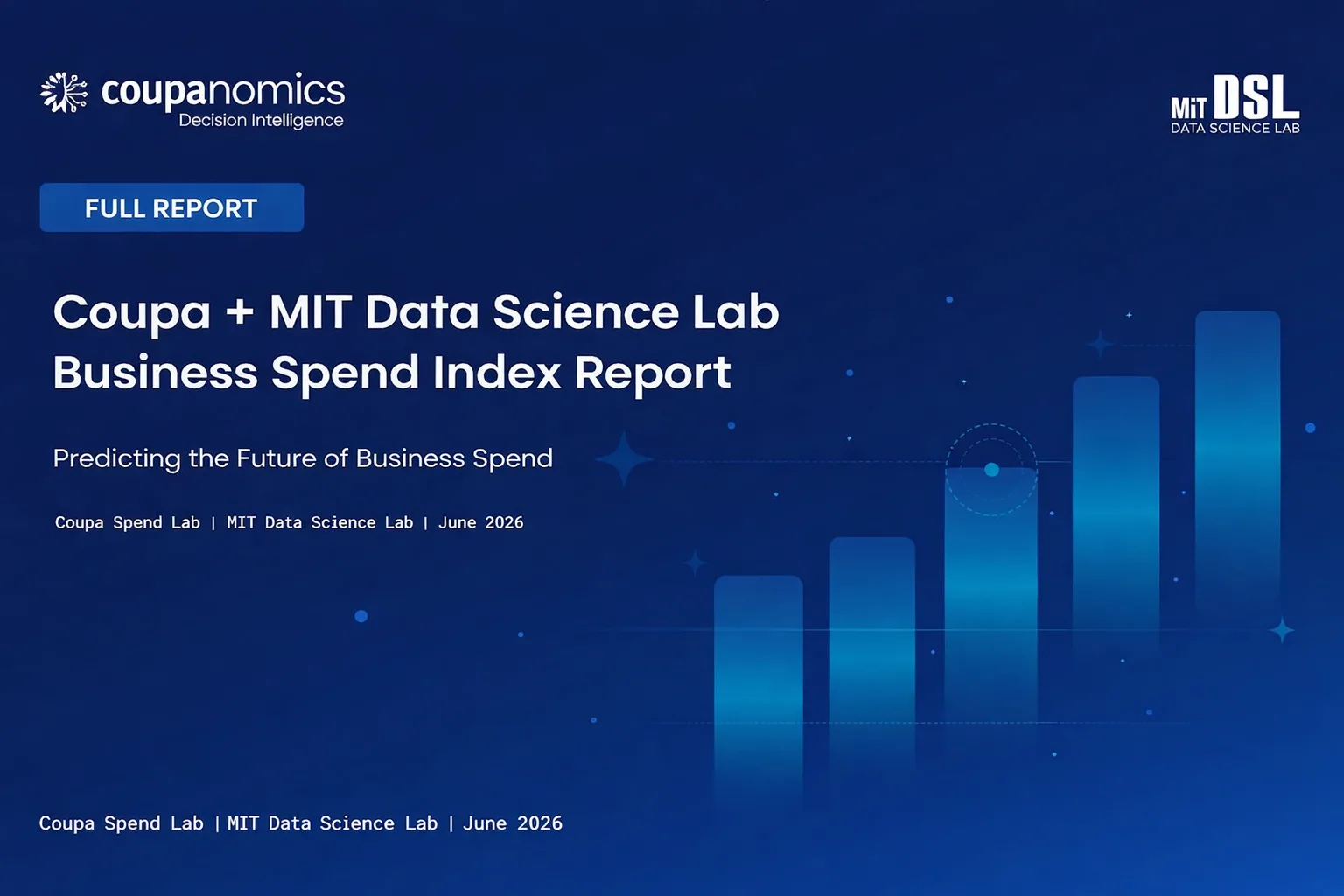
Coupa has launched the Coupa + MIT Data Science Lab Business Spend Index (BSI) Report, introducing what the company describes as a new economic indicator designed to provide procurement and business leaders with forward-looking visibility into spending trends.
- New AI-Driven Index Uses Real Procurement Data to Forecast Business Spending Trends
- Key BSI Findings:
- Moving Beyond Traditional Economic Indicators
- Procurement Data Provides Early Economic Signals
- Procurement Spend Expected to Contract in Several Sectors
- Manufacturing and Technology Investment Trends Emerge
New AI-Driven Index Uses Real Procurement Data to Forecast Business Spending Trends
Built on Coupa’s $10 trillion dataset of actual business-to-business transactions, the index combines artificial intelligence, machine learning and econometric modelling to forecast business spend movements up to 90 days in advance.
According to Coupa, the initiative aims to help procurement, finance and supply chain leaders make more informed decisions by providing near real-time insight into changing market conditions and spending behaviour.
Key BSI Findings:
- BSI Catches April Spend Pullback Before Surveys: All five tracked sectors registered month-over-month spend declines in April 2026, from −0.8% in Manufacturing to −3.3% in Business Services. In comparison, ISM PMI’s Manufacturing & Services surveys predicted the industry would expand in April.
- Sector Contractions Predicted Over the Summer: The BSI is predicting that procurement spend will contract in sectors of High Tech, Financial Services, and Healthcare & Life Sciences over the summer. Financial Services is the sector forecasted to see the largest contraction.
- Tech’s Bet on AI is Yielding Enterprise Demand: High Technology procurement spend has climbed more than 40% since mid-2024 to a four-year cycle high. Tracking enterprise software and services procurement, the BSI provided a definitive early signal that enterprise demand is catching up to the massive AI infrastructure build-out commitments made.
- From Tariff Shock to AI Investment: Smaller U.S. manufacturing firms were forced to slash spend by 17.5% to survive 2025 tariff volatility, compared to just 14.6% for larger manufacturing firms. The February 20, 2026 Supreme Court tariff ruling introduced a significant source of policy stabilization, allowing businesses to shift away from short-term defensive maneuvers and return to long-term strategic investments in automation and AI-enabled execution systems.
- Manufacturing Invests in Resilience Despite Soft Demand: Typically, manufacturing spend only rises to meet surging customer orders. However, the BSI showed that late 2025 manufacturing spend surged even though new customer demand remained soft. Spurred by full expensing provisions in the July 2025 “One Big Beautiful Bill Act” (OBBBA), manufacturers are taking advantage of tax breaks to make bold internal investments in automation, capability, and supply chain resilience.
Moving Beyond Traditional Economic Indicators
The Business Spend Index was developed through a collaboration between Coupa and the MIT Data Science Lab to provide a more immediate view of business spending activity.
Unlike traditional economic indicators that can be revised after publication, the BSI is based on actual procurement transactions occurring across Coupa’s network of more than 10 million buyers and suppliers.
The index measures committed spend activity and is designed to capture market dynamics as they occur, providing visibility into business investment patterns before they are reflected in broader economic data.
According to the companies, the BSI successfully identified a significant turning point in manufacturing activity three months before it was reflected in the ISM Purchasing Managers’ Index (PMI).
Procurement Data Provides Early Economic Signals
The report is based on anonymised procurement data representing $877.9 billion in 2025 spending across 1,487 Coupa customers operating in sectors including manufacturing, high technology, financial services, business services, and healthcare and life sciences.
By analysing actual purchasing commitments rather than executive sentiment surveys, the index seeks to provide a clearer view of business activity and investment intentions.
“With visibility into trillions of dollars of actual business spend, you don’t guess where the economy is going, you see it unfolding in real-time,” said Kevin Iaquinto, Chief Marketing Officer, Coupa. “By leveraging Coupa’s unmatched proprietary dataset and combining it with the best macroeconomic indicators and AI, MIT Data Science Lab and Coupa have collaborated to deliver a report that has tremendous business value for procurement, supply chain, and other business leaders who are debating and actioning future spend decisions.”

David Simchi-Levi, William Barton Rogers Professor and Head of the MIT Data Science Lab (retired), added: “Coupa has a very unique dataset that offers the basis for incredible economic insights. By applying rigorous econometric modeling and statistical analysis, we have mathematically observed that Coupa’s data has strong leading signals relative to numerous established macroeconomic indicators, such as FRED, IDEA, ISM PMI, and Real GDP.”
Procurement Spend Expected to Contract in Several Sectors
Among the report’s key findings, the BSI identified month-on-month procurement spend declines across all five tracked sectors during April 2026.
The index also forecasts procurement spending contractions during the summer across the High Technology, Financial Services, and Healthcare & Life Sciences sectors, with Financial Services expected to experience the largest decline.
The findings are intended to help procurement teams anticipate changes in supplier demand, budget allocation and sourcing strategies.
Manufacturing and Technology Investment Trends Emerge
The report highlights several significant procurement trends across key industries.
In manufacturing, the BSI found that smaller U.S. manufacturers reduced spending by 17.5% during 2025 tariff volatility, compared with a 14.6% reduction among larger manufacturers.
According to the report, policy stabilisation following a February 2026 U.S. Supreme Court tariff ruling has enabled organisations to shift focus from short-term defensive spending towards longer-term investments in automation and AI-enabled operational systems.
The report also found that procurement spend within the High Technology sector has increased by more than 40% since mid-2024, reaching a four-year cycle high.
Coupa said this trend indicates growing enterprise demand for software and technology services following significant investments in AI infrastructure.
This article was produced by the editorial team at North America Outlook and published as part of the Outlook Publishing global network of B2B industry magazines.
Outlook Publishing delivers industry insights, company stories, and sector coverage across manufacturing, mining, construction, healthcare, supply chains, food production, and sustainability.
North America Outlook provides ongoing coverage of organisations and developments shaping industries across North America.